Minesweeper XY: both sides of the field are yours

Minesweeper XY took the path from the original Minesweeper and promoted its setting to the main event: the player sets path length and row width separately, 3 to 15 steps and 2 to 6 squares respectively. The stated RTP is unchanged at 98.4, the best in the set. What moves is the shape of a round, and it moves further than a mine count moves a classic grid.

Studio
BGaming
Stated RTP
98.4%
Released
March 2022

Play Minesweeper XY

What each of the two axes does

The XY is literal: two independent sliders, and they behave differently.

Row width: risk per step

In a row of 2 squares the bomb is under one of two and a step clears about half the time. In a row of 6 it is under one of six and the step is nearly safe. Width does not touch the length of a round; it decides whether the round survives to the end of it.
Path length: how many steps are needed

From 3 to 15 rows. Length sets how high the multiplier can climb, but with narrow rows the end of a long path is rarely reached: probabilities multiply, and fifteen narrow steps in a row is a rare event.

The combination: four different games

Short and wide is a near-certain small win. Short and narrow is a coin flip. Long and wide is unhurried accumulation. Long and narrow is a hunt for the top of the ladder. The return across all four is much the same; the experience is not.

How it reads on screen

Frames from the BGaming demo, with multipliers printed on the field itself.

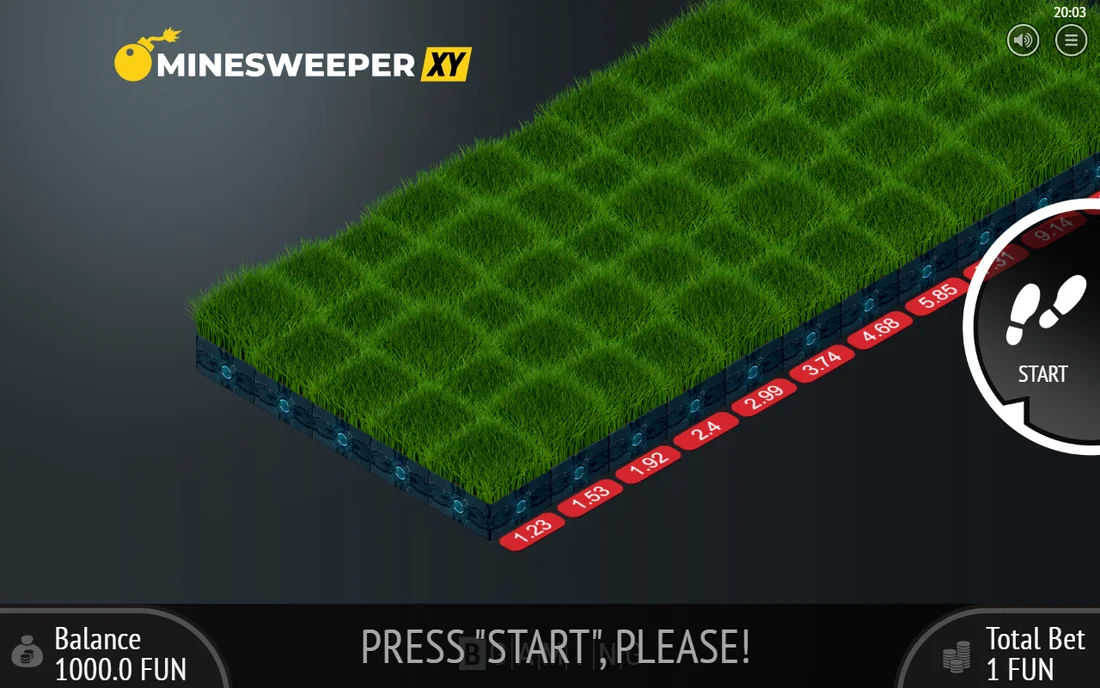
Minesweeper XY in the BGaming demo: the path recedes into the distance, each row carrying its own multiplier
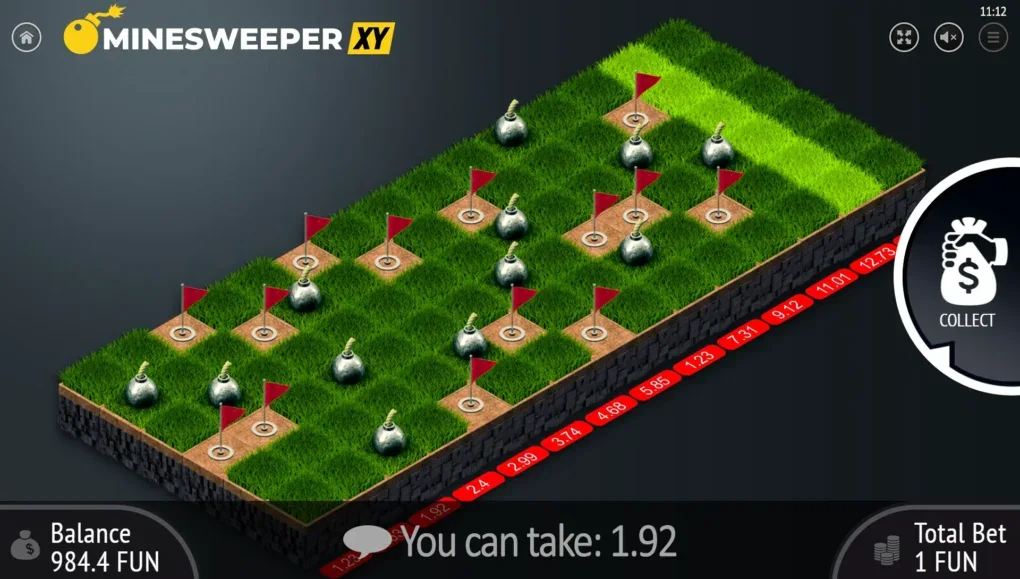
A Minesweeper XY frame from studio material: the field at the moment of choosing a square in the next row

Multipliers are printed beside every row before the first step is taken. That is a real convenience next to a classic grid, where the current multiplier appears as one figure in a panel and working out what the next tile is worth means holding the ladder in your head. Here the whole ladder is visible at once, and the exit point is chosen with your eyes rather than your memory.

Configurable fields: who else went this way

The idea of handing field size to the player surfaced at two studios in 2022.

Turbo Mines by Turbo Games shipped in September 2022 offering four square boards: 3x3, 5x5, 7x7 and 9x9. Minesweeper XY arrived in March of the same year and solved the same problem differently: the field is not square, and its sides are set independently.

The practical difference matters. On Turbo Mines a bigger board lengthens the ladder and raises the mine count together, so the modes differ by scale. On Minesweeper XY length and risk sit on separate sliders, which allows configurations a square board cannot produce - a very long path that is also very safe, for instance.

The trade-off is the ceiling. Turbo Mines caps at x805001; the BGaming titles state maximums orders of magnitude lower, with the first Minesweeper at x15.11. Configurability without heavy risk is paid for with the absence of a heavy win.

How mines returns are calculated

Who this version suits

Anyone who wants finer control over the shape of a round than a single mine-count slider allows. And anyone playing long sessions: 98.4 is the best return in the set, and the absence of a huge ceiling means the money is distributed into frequent small payouts rather than saved up for a rare event.

It does not suit a hunt for a large multiplier. There is none here by design, and that is a deliberate studio decision rather than an oversight. Large multipliers live on the classic grid - with Mines+ or Book of Mines.

How does Minesweeper XY differ from plain Minesweeper

The XY in the name is the two axes of the field. The original has the setting too, but XY builds the game around it: both sides of the path are set separately, and their combination decides both step frequency and how steeply the ladder climbs.

Which configuration is riskiest

A long path with narrow rows: 15 steps of 2 squares each. Every step clears roughly half the time, and clearing all fifteen is close to impossible. The opposite extreme is a short path with wide rows - 3 steps of 6 squares, where a round almost always finishes and pays very little for it.

Does the field configuration change the RTP

Slightly. The stated 98.4 applies to part of the configuration space; other combinations of length and width return marginally less. The spread is small, but it is one of those cases where the shop-front figure is the top of a band rather than a constant.

When was Minesweeper XY released

March 2022, six years after the first Minesweeper. That is the same year Turbo Games shipped Turbo Mines with four grid sizes: two studios arrived independently at the idea that field configuration belongs to the player.

Last updated -