
Turbo Mines: boards from 3x3 to 9x9, and a replayed pattern
Turbo Mines is the first game in this set where the player picks the board size. Classic mines does one board, 5x5; here there are four, up to a 9x9 of 81 tiles. That is where its x805001 ceiling comes from, the highest at Turbo Games. The second thing its neighbours lack is turbo mode: the game remembers a tile pattern and replays it round after round on its own.
- Studio
- Turbo Games
- Stated RTP
- 95%
- Field size
- 3x3, 5x5, 7x7, 9x9
- Multiplier ceiling
- x805001
- Released
- September 2022
What the screen shows
Captured in the studio demo, with the size switcher sitting first in the panel.
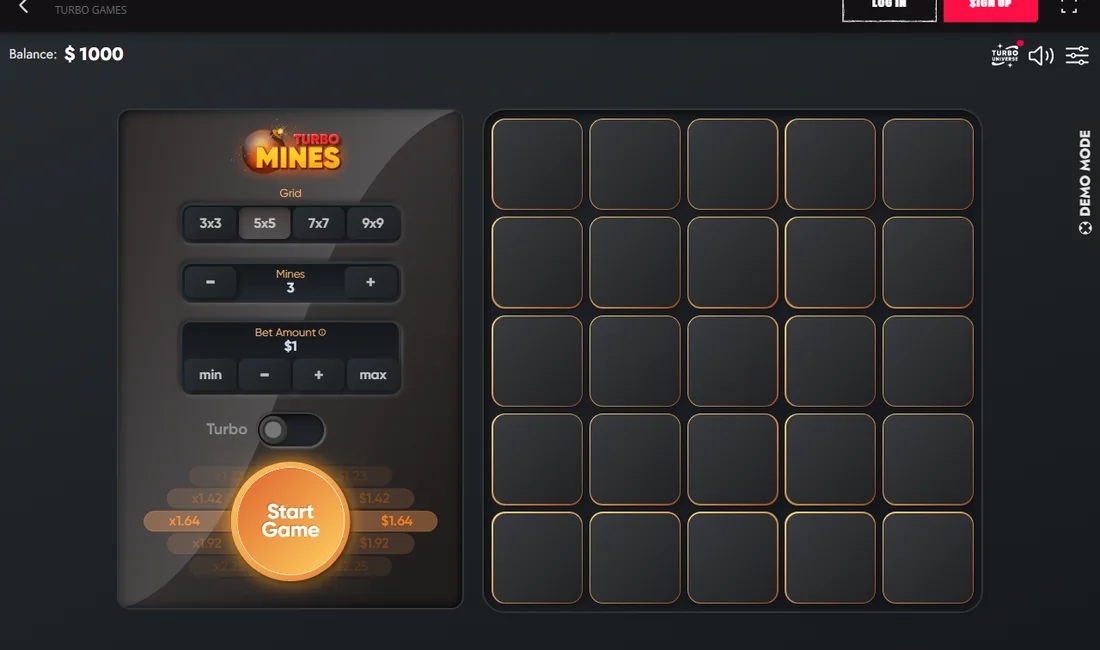
The left panel runs as a single column: board size first, then mine count, then stake and the turbo toggle. The order is not accidental - in this game the board is chosen first, because it governs both the available mine range and the entire multiplier ladder.
How board size rewrites the maths
More tiles means a longer ladder, and a longer round.
A 3x3 board holds nine tiles. Even at one mine the whole ladder fits into eight rungs, and the ceiling here is limited by the board itself. This is the mode for very short rounds: two or three clicks and the decision is made.
A 5x5 board is the familiar 25 tiles and the same maths as everything else in this set: at 3 mines the click lands 88 times in a hundred, at 10 mines 60. Every table on the odds page applies to this mode without rescaling.
A 9x9 board is 81 tiles, and that is what people take this game for. So many tiles are safe that a run of twenty clicks stops being fantasy, and the multipliers behind such a run reach six figures. That is where x805001 comes from, and also why a 9x9 round takes a minute rather than five seconds.
Turbo mode: what it is really for
The name promises speed. Its usefulness lies elsewhere.
The mechanic is simple: mark a set of tiles, set a round count, and the game runs your set for you. Speed does go up, and that is also the main hazard - bets leave faster than you can think about them, and a minute of turbo covers what ten minutes of manual play would.
The genuine benefit is different. A pre-named exit point is the one habit that actually works in mines, and it always fails in the same place: the moment a tile opens well and one more looks irresistible. Turbo mode deletes that moment - the set was fixed before the round and cannot be edited mid-play.
So the sane way to use it is together with a capped round count and a flat stake, and never with the intention of winning something back. Why the second one fails is worked through in the strategy breakdown: doubling burns a bankroll across eight losses in a row, and at turbo speed eight losses take well under a minute.
Is Turbo Mines worth taking
Yes, for a large multiplier: x805001 is second in this set behind the x5070293 of Mines+, and it is reached on a board nobody else offers. Yes too, if playing with board size appeals: Book of Mines offers the same four sizes in Egyptian dress.
No, if return is what matters. An RTP of 95 is the middle of the set, and the same classic 5x5 grid carries better options: Hot-mines at 97 and Mines+ at 97.5. Board size here is paid for with two and a half points of return - a fair trade, but a trade.
Which grid sizes does Turbo Mines offer
Four: 3x3, 5x5, 7x7 and 9x9. That is nine, twenty-five, forty-nine and 81 tiles. Classic mines only ever does the second size; here the board can be shrunk to nine tiles or stretched to eighty-one.
What does turbo mode do
It stores your tile pattern and replays it round after round without input. Its value is not speed: repetition takes the decision out of each individual round, and that is precisely where a pre-named exit point usually breaks.
How much does a 9x9 board change the game
A great deal. Across 81 tiles the multiplier ladder runs several times further than it does across 25, and that is where the x805001 ceiling comes from. The cost is length: reaching an interesting multiplier means dozens of clean clicks in a row.
How does it differ from plain Mines by the same studio
Grid sizes and ceiling. The early Mines of May 2021 has one board and a ceiling of x456660; Turbo Mines of September 2022 has four boards and x805001. The stated RTP is 95 on both.