
Minesweeper by BGaming: a path instead of a grid, at RTP 98.4
Minesweeper is the only game here with neither a grid nor a mine count, and it is also the most generous of the sixteen: a stated RTP of 98.4. Instead of a field there is a path of rows, and instead of clicking any tile you pick one square per row. The price of that high return is visible immediately - a multiplier ceiling of just x15.11.
- Studio
- BGaming
- Stated RTP
- 98.4%
- Multiplier ceiling
- x15.11
- Released
- April 2016
How a round on the path works
The mechanic is far enough from classic mines that a description rarely covers it.
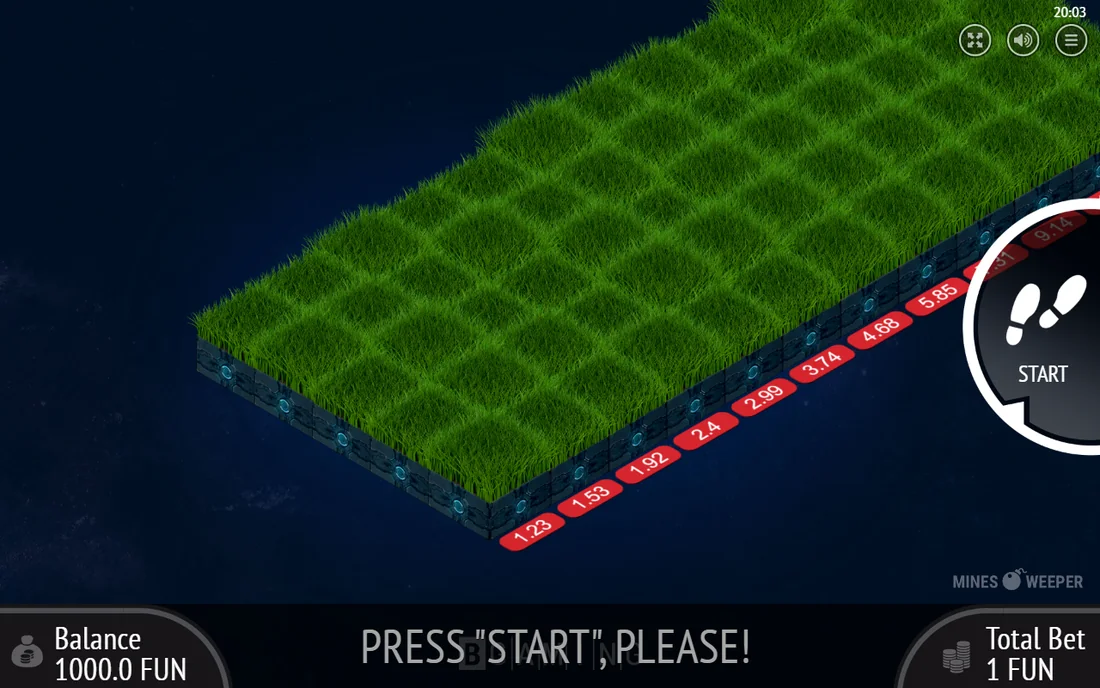
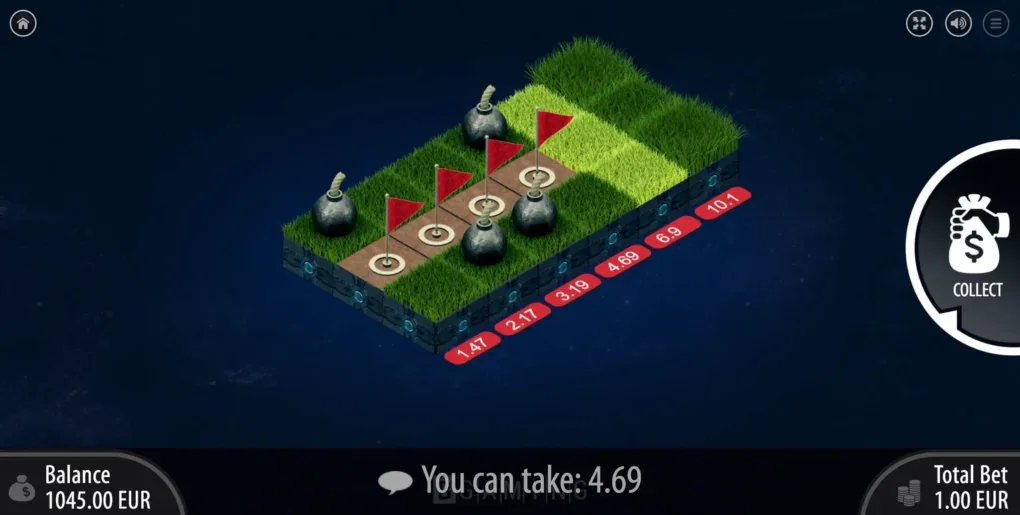
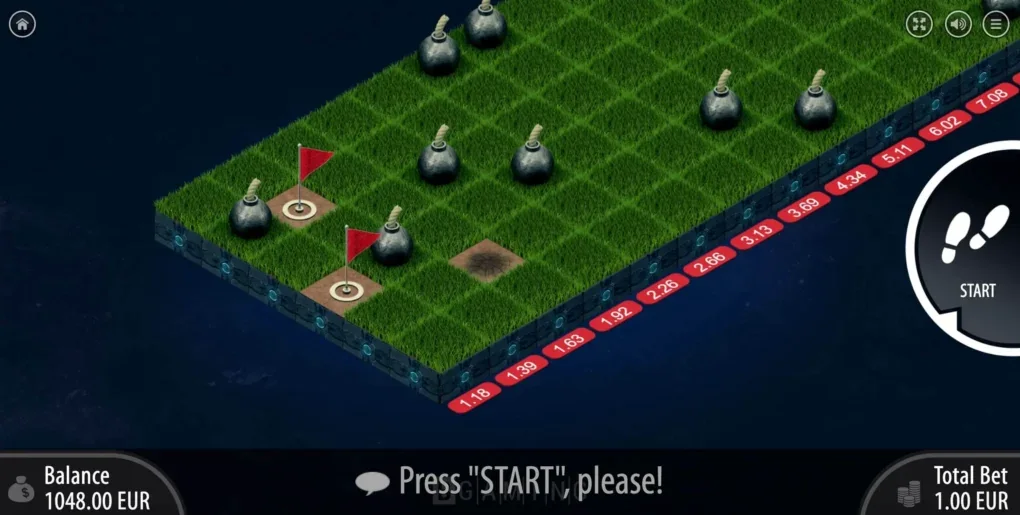
The field lies in front of the player as a path running away into the distance. Each of its transverse rows holds several squares with exactly one bomb among them. You pick a square, take the step and arrive at the next row. The multiplier for every row cleared is printed on the field itself, and the collect button is live after any step.
Hence the key departure from a classic grid. There, risk rises with every click: fewer tiles remain while the mine count stays put. Here risk is constant - one bomb per row, and the row width never changes. A round does not get more dangerous towards the end, it simply continues.
Two sliders in place of a mine count
The setting behaves differently here, and it shapes the whole ladder.
The first slider is path length: 3 to 15 steps. The second is row width: 2 to 6 squares. A row of two means a step clears roughly half the time; a row of six means it almost always clears. The price of a step moves accordingly.
A short narrow path plays like flipping a coin a few times: few steps, each risky, the multiplier climbing steeply. A long wide path is the opposite - fifteen nearly safe steps and a slowly accumulating sum. Both extremes deliver the same return; only the shape of the distribution differs.
Those two sliders are also why the real RTP drifts slightly around the stated one: different field configurations return slightly different figures, and 98.4 is the top of that band. The spread is small, but it is worth knowing about.
Why high return and low ceiling travel together
Not a coincidence but a direct consequence of how the maths is built.
A game's return is the average across every possible outcome. When one of those outcomes is enormous it absorbs a visible share of that average and everything else gets less. That is how classic mines work: the ten-mine, fifteen-tile row with its million-fold multiplier exists because every short round pays a little more meanly.
Minesweeper removed the enormous outcome. A ceiling of 15.11 means the distribution is compressed with no long tail to finance. What remains is spread across frequent small payouts, and the return rises to 98.4, the highest figure in the set.
The practical choice follows directly. For long play with minimal bleed, Minesweeper suits better than any of the sixteen. For a rare big multiplier it is simply not the game: that lives on the classic grid, with Mines+ at x5070293 or Turbo Mines on a 9x9 board.
The oldest game in the set
Minesweeper arrived in April 2016, five years before the instant-win wave that began with Mines by Turbo Games in May 2021. It shows in the build: the game makes no attempt to be fast, carries no fifty-round autoplay or bonus buy, and instead offers an unhurried step animation and an explosion sound that makes losing almost watchable.
The studio demo is open: the game launches from the BGaming page with no account, on play credits. For this title in particular a demo earns its keep, because the path mechanic is harder to grasp from a description than from two rounds.
Why does Minesweeper have the highest RTP
Because its ceiling is low. The maximum multiplier here is x15.11 rather than the hundreds of thousands a classic grid can reach. The studio spends no maths on vanishingly rare huge payouts and returns it into frequent small ones instead, which is where 98.4 comes from.
How does a path differ from a 5x5 grid
In what you choose. On a grid you click any remaining tile. Here every move is a row of several squares with exactly one bomb among them. Row by row you cross from one edge of the field to the other, and the multiplier climbs with each row cleared.
How is difficulty set
With two sliders. Path length runs from 3 to 15 steps and row width from 2 to 6 squares. A narrow row means high risk per step, a wide one low. A long path stretches the multiplier ladder out; a short one makes the round nearly instant.
When did the game come out
April 2016. It is the oldest title in this set, older than the whole instant-win wave that started in 2021. The mechanic has not changed since; what changed was the arrival of the XY version with a configurable field.